
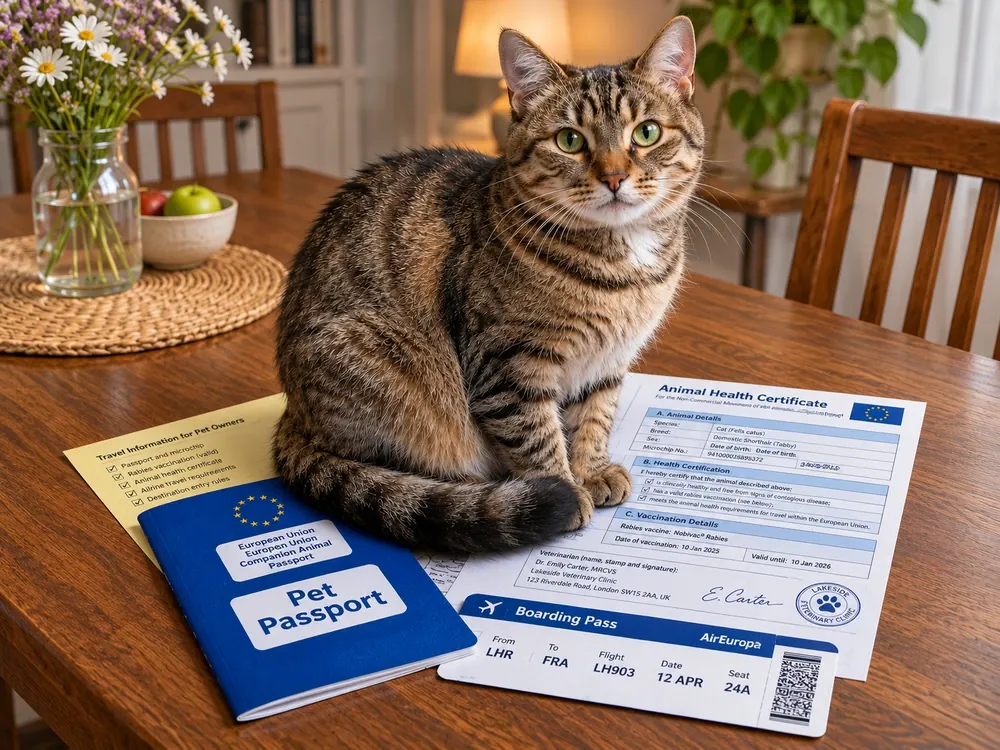
In October 2026, the EU updated its animal health certificates for dogs, cats and ferrets.
If you are travelling between EU countries with your pet and have a valid EU pet passport, you do not need a new health certificate because of the October changes.
These changes mostly affect animals coming into the EU from non-EU countries. This includes pets travelling with their owners and dogs, cats or ferrets entering under consignment or standard movement rules.
This difference is especially important for rescue organisations, adopters and anyone organising animal transport across borders.
In this guide
- Who is affected by the new EU health certificates?
- What changed on 1 October 2026?
- What changed on 17 October 2026?
- What is the difference between non-commercial and standard movement?
- Are old health certificates still valid?
- What about EU pet passports?
- Why do the microchip details matter?
- How long is a non-commercial animal health certificate valid?
- What do the changes mean for rescue animals?
- What should you check before travelling?
- Official EU rules
Who is affected by the new EU health certificates?
The first question is whether the animal actually needs an animal health certificate.
For many dogs, cats and ferrets entering the EU from a non-EU country, the answer is yes.
For a normal non-commercial movement, the animal travels with its owner, or with an authorised person connected to the owner’s journey. The movement must not be intended for the sale or transfer of ownership of the animal.
If someone else transports the pet, the owner normally needs to travel within five days before or after the animal. Non-commercial movement is also normally limited to five pets.
But not every animal entering the EU needs an animal health certificate.
There are exceptions. For example, qualifying pet passports issued in certain listed non-EU countries or territories can be used instead. An EU pet returning after travel outside the EU may also be able to re-enter using its existing pet passport when the required information was completed before it left the EU.
And if you are travelling from one EU country to another with a valid EU pet passport, the October 2026 health-certificate cut-offs are not the rules you need to worry about.
What changed on 1 October 2026?
The 1 October 2026 date concerns the animal health certificate used for non-commercial movements of pet dogs, cats and ferrets from non-EU countries or territories into the EU.
Commission Implementing Regulation (EU) 2026/705 introduced the new certificate model.
There is a transition for the previous certificate.
An old-model certificate remains covered by the transition if it was issued before 1 October 2026. Those certificates can continue to be accepted during the transitional period until 31 March 2027.
This difference is important.
Not every old certificate became invalid on 1 October.
It means that a certificate issued from 1 October onwards needs to use the new model. A qualifying old-model certificate issued before that date can still be used during the transition.
The EU rules began earlier in 2026, but the transition period gave vets, authorities and travellers time to switch from the old paperwork to the new certificate.
What changed on 17 October 2026?
The 17 October 2026 date applies to a different certificate.
Commission Implementing Regulation (EU) 2026/848 changed the model animal health certificate used for the entry into the EU of consignments of dogs, cats and ferrets.
The previous Chapter 38 certificate can still be used during a transition ending on 17 January 2027, provided that the certificate was issued no later than 17 October 2026.
In practice:
A qualifying old certificate issued on or before 17 October can still be accepted during the transition.
A certificate issued after 17 October needs to follow the new model.
The two October dates are not competing deadlines.
Each date applies to a different route.
1 October: non-commercial pet movements from outside the EU.
17 October: consignments and other movements using the Chapter 38 entry certificate.
What is the difference between non-commercial and standard movement?
This part can be a bit less clear. “Non-commercial” does not simply mean that nobody made a profit.
It is a specific legal category.
A non-commercial movement is a movement that is not intended for the sale or transfer of ownership of the pet. It also normally involves the owner travelling with the animal, or an authorised person moving it in connection with the owner’s own journey.
If those conditions are not met, the animal may have to travel under the rules for standard movements or consignments instead.
That can mean different certificates, different entry procedures and additional official controls.
This distinction is especially important for:
- rescue organisations
- shelters
- international adoptions
- animals transported to new owners
- breeders
- professional animal transport
- movements involving more than five pets
The term “commercial” can be misleading. A charity does not suddenly become a commercial business because it moves a rescue dog.
But the movement itself may still fall outside the EU rules for non-commercial pet travel.
Are old health certificates still valid?
Yes, in some cases.
The issue is not simply whether the certificate uses the old design. The date it was issued matters.
For non-commercial pet movements, the old certificate model can remain valid under the transition if it was issued before 1 October 2026. The transitional period runs until 31 March 2027.
For consignments of dogs, cats and ferrets, the old Chapter 38 certificate can continue to be used until 17 January 2027, provided it was issued no later than 17 October 2026.
If you are arranging travel now, it is easiest not to search for an old form or try to work out if it still qualifies.
Ask the official or authorised vet to use the current certificate model for the type of movement involved.
What about EU pet passports?
An EU pet passport and an animal health certificate are not the same document.
If your dog, cat or ferret is travelling between EU countries and has a valid EU pet passport, you do not need to replace it simply because the health-certificate models changed in October 2026.
The EU has also introduced new passport models, but transitional rules mean qualifying passports issued under the previous model before 1 January 2028 can continue to be recognised.
If you live in Spain and drive to France with your dog and a valid EU pet passport, the 1 October and 17 October health-certificate deadlines do not mean you need another document for your trip.
Different rules apply when an animal is entering the EU from outside the EU.
Why do the microchip details matter?
ChipTrace pays special attention to this part.
The animal health certificate does not just say that the animal has a microchip.
The EU rules require identification information including:
- the unique microchip or transponder code
- the location of the transponder
- the date of identification or reading of the transponder
- information identifying the animal
- owner contact details
- rabies vaccination information
- rabies antibody test information where required
- relevant Echinococcus multilocularis treatment where applicable
Commission Delegated Regulation (EU) 2026/131 specifically requires the certificate to include the transponder location, the identification or reading date and the unique identification code.
That means the microchip number on the certificate needs to be correct.
A single wrong digit is not just a minor error. It could mean the animal at the border seems to have a different identification number from the one in its health documents.
Before the certificate is issued, compare the complete microchip number carefully with the scanner reading and the animal’s other records.
If you want to understand what the number itself can tell you, read our guide to pet microchip numbers.
How long is a non-commercial animal health certificate valid?
For a pet entering the EU under the non-commercial rules, the health certificate is normally valid for 10 days from the date of issue until the required documentary and identity checks at the EU point of entry.
For travel by sea, that period is extended by the duration of the sea journey.
After the animal has entered the EU and passed the required checks, the certificate can be used for onward movement between EU countries for up to six months, or until the rabies vaccination expires, whichever happens first.
This helps if you enter the EU in one country and then travel on to another.
What do the changes mean for rescue animals?
Rescue animals need extra attention because the word “pet” can make the rules seem simpler than they really are.
An animal being moved by a rescue organisation is not automatically travelling under the non-commercial pet rules.
The purpose of the movement, who owns the animal, whether ownership is changing, who is travelling with it and how the transport is arranged can all affect which set of rules applies.
The European Commission specifically states that movements of dogs, cats and ferrets sourced from shelters must comply with the animal-health conditions for entry into the EU.
For rescues, make sure you know the correct movement category before getting the certificate.
Do not assume that a volunteer travelling with a rescue dog automatically makes it ordinary pet travel.
Also, do not assume every rescue movement is “commercial” just because standard entry rules apply.
The legal route depends on the actual movement.
For international adoptions and rehoming from outside the EU, check the requirements with the competent authority, official vet or border-control authority before transport is booked.
What should you check before travelling?
If a dog, cat or ferret is entering the EU from outside the EU, start by working out which movement rules apply.
Then check:
- whether the animal needs an animal health certificate or can use a qualifying passport
- whether the movement is genuinely non-commercial
- whether the correct 2026 certificate model is being used
- that the complete microchip number matches the scanner and paperwork
- that the rabies vaccination was given after the animal was identified as required
- whether a rabies antibody titration test is required for the country of origin
- whether a dog needs Echinococcus multilocularis treatment for the destination
- whether the animal must enter through a designated travellers’ point of entry or border control post
- whether additional rules apply because the animal is being adopted, rehomed or transported by an organisation
The new forms do not change the main reason for these documents. They link each animal to its health history and the conditions for entering the EU.
This all starts with one small but important detail:
the right microchip number.
For practical next steps, read our guide to microchip checks before travelling with your pet.
Official EU rules
The main 2026 rules behind these changes are:
Commission Delegated Regulation (EU) 2026/131 — animal health requirements for non-commercial movement of pet animals.
Commission Implementing Regulation (EU) 2026/705 — new identification documents, declarations and animal health certificate models for non-commercial pet movements.
Commission Implementing Regulation (EU) 2026/848 — updated animal health certificates for movements and entry into the EU of consignments of dogs, cats and ferrets.