
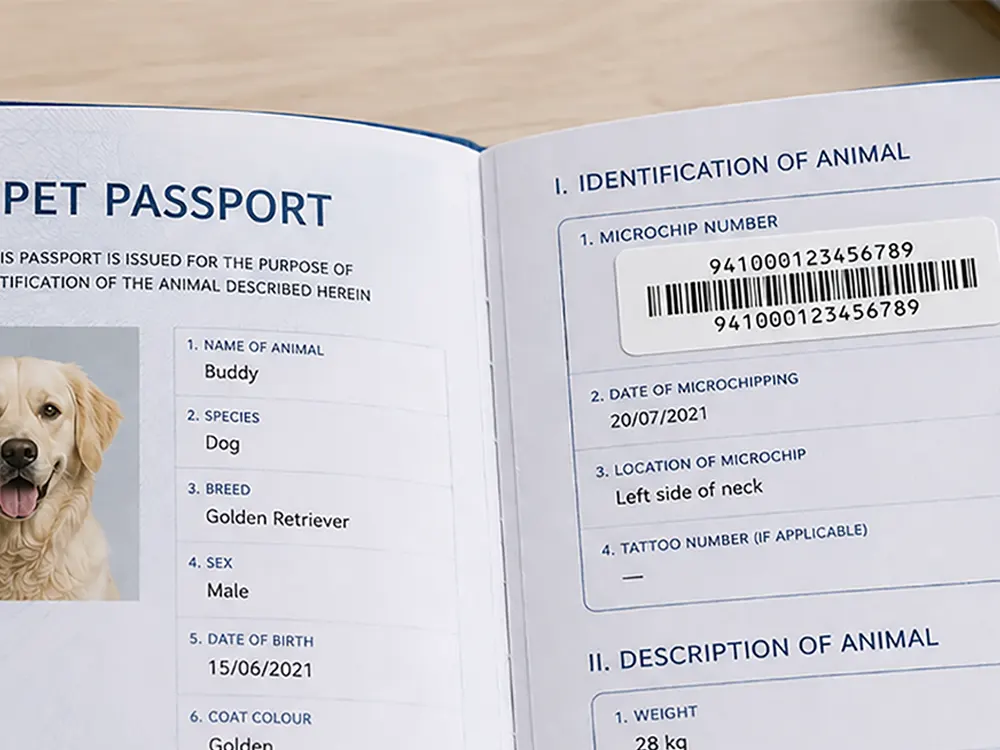
Pet microchip numbers can give helpful information about the chip, such as the system that issued it. However, the number alone does not reveal everything about the animal, its owner, or its current registration.
Most modern pet microchips have 15 digits. However, some older chips with 9- or 10-digit codes are still used today.
This guide explains what the digits in a microchip number can show, what they cannot prove, and why having the full number is important.
In this guide:
- What does a pet microchip number look like?
- Why do most modern microchips have 15 digits?
- What do the first three digits mean?
- What is a country-coded microchip?
- What is a manufacturer-coded microchip?
- Does one prefix always identify one manufacturer?
- Can a microchip number reveal the pet’s nationality?
- What do the remaining digits mean?
- Why does one incorrect digit matter?
- What is a 9-digit microchip number?
- What is a 10-digit microchip number?
- Can letters appear in a pet microchip number?
- Where can I find my pet’s microchip number?
- Can I identify the registry from the number?
- Can two pets have the same microchip number?
- How ChipTrace interprets a microchip number
- Check a microchip with ChipTrace
What does a pet microchip number look like?
A pet microchip number is a unique ID stored on the chip placed inside the animal.
A modern pet microchip number might look like one of these:
941000025991260985112000508169276098102345678528140000123456826123456789012
These examples show typical 15-digit formats. The first three digits can hint at the country, manufacturer, or how the chip was assigned, but they do not confirm where the pet is registered.
A pet microchip number may contain:
- 9 digits
- 10 digits
- 15 digits
Most modern chips use the 15-digit international format. Shorter numbers are usually linked to older identification systems.
The chip itself usually only stores the identification number. The owner’s name, phone number, and other contact details are kept separately by a microchip registry.
The AAHA Microchip Registry Lookup tool accepts valid 9-digit, 10-digit and 15-digit chip numbers.
Why do most modern microchips have 15 digits?
The 15-digit format meets international standards for electronic animal identification.
For example, a 15-digit microchip number may look like this:
900111000123456
The full number identifies a single chip. Different parts of the number can also give clues about the system, country, or manufacturer that issued it.
The first three digits are usually the main prefix. They might be a manufacturer code or an official country code.
The next digits complete the chip’s unique number. In some systems, they can also show a product range or another type of assignment. For certain ranges, an extra digit can help tell a regular chip number from a test or reserved number.
This is why ChipTrace checks the whole number instead of just the first three digits.
What do the first three digits mean?
When looking into a 15-digit chip, the first three digits are often the best place to start.
They normally represent one of two things:
- An authorised numeric country code
- A manufacturer code
Manufacturer codes usually fall between 900 and 998. These numbers show which manufacturer produced the chip.
A country-coded chip uses the three-digit numeric code assigned to that country under the ISO 3166 system. A country code may be used for animal identification only when the responsible national authority controls and authorizes its use.
What is a country-coded microchip?
A country-coded microchip begins with an authorised three-digit numeric country code.
For example, the ISO numeric code for the United States is 840. The United Kingdom uses 826.
The UK code covers the United Kingdom as a whole: England, Scotland, Wales and Northern Ireland. These countries do not each have a separate ISO numeric country code.
Nearby Crown Dependencies are different. Jersey, Guernsey and the Isle of Man each have their own numeric codes.
So, a country prefix should be read carefully. It can point to a national identification system, but it does not always show exactly where in the country the chip was implanted.
It also does not prove:
- Where the animal was born
- Where the animal currently lives
- Where the chip is now registered
- That the animal has never moved abroad
A pet may have been chipped in one country and later moved, imported or adopted in another.
A country code is a helpful starting point, but it does not tell the whole story of the animal.
What is a manufacturer-coded microchip?
A manufacturer-coded chip begins with a code assigned to a microchip manufacturer.
These codes are commonly found between 900 and 998.
A manufacturer might supply chips to clinics, distributors, shelters, and rescue groups in different countries. The prefix can show the manufacturer, but not where the chip was implanted or registered.
When no registration is found, the manufacturer may still be able to help trace:
- The distributor that received the chip
- The country or region that received the batch
- The clinic, shelter, or rescue that purchased it
- The registry normally used with that range
Does one prefix always identify one manufacturer?
Not necessarily.
Codes and number ranges can change over time. A manufacturer may use several ranges, while older allocations may later be connected to another company or distributor.
There may also be additional information in the digits that follow the main three-digit prefix.
This is why you should not rely on memory alone to interpret a prefix. Always check the full number against up-to-date manufacturer and registry information.
Can a microchip number reveal the pet’s nationality?
No. A microchip number only identifies the chip, not the animal’s nationality.
The number may suggest the system under which the chip was issued. However, the animal may later have:
- Moved abroad with its owner
- Been adopted internationally
- Entered another country through a rescue
- Been registered again after moving
The number can help guide a search, but it should not be seen as proof of the animal’s birthplace, nationality, or ownership.
What do the remaining digits mean?
The digits after the main prefix complete the chip’s unique identification number.
Depending on the system, some of these digits may also identify a product range, allocation, or type of number.
For example, a particular digit may sometimes help distinguish a live chip range from a test or reserved range. This is not a universal rule for every chip, so it must be checked against the system used for that number.
Owners and finders usually do not need to figure out each digit themselves. The most important thing is to copy and search the full number correctly.
Why does one incorrect digit matter?
Every single digit is important.
Changing, missing, or reversing a single digit creates a different number. This may produce:
- No search result
- The wrong manufacturer information
- The wrong country clue
- A completely unrelated registry record
Before searching:
- Compare the number with the scanner display
- Check handwritten numbers carefully
- Watch for similar-looking digits, such as 0 and 8
- Do not guess a missing digit
- Ask for another scan when the number is unclear
Spaces and dashes are not usually part of the chip number. When searching, use only the digits.
What is a 9-digit microchip number?
A 9-digit number is typically associated with an older microchip system.
The chip can still work properly, even if it does not use the modern 15-digit format.
An older chip can sometimes be harder to trace because:
- Some lookup services do not recognise the format
- The original registry may have closed or changed
- The manufacturer may now trade under another name
- Not every scanner can read every older chip type
A shorter number does not mean the chip is fake or broken.
What is a 10-digit microchip number?
A 10-digit number is also usually an older format.
Like a 9-digit chip, it may still identify the animal correctly when it can be scanned and traced.
Do not add zeros to make the number 15 digits. Search for it exactly as it appears on the scanner or in the official paperwork.
Can letters appear in a pet microchip number?
Modern ISO pet microchip numbers typically contain only digits.
Older systems or documents may show letters, labels, or other reference numbers near the chip number.
If you are not sure, ask a vet or shelter to confirm which characters make up the implanted chip number.
Do not include unrelated information such as:
- Spaces or dashes
- Registry reference numbers
- Pet passport page numbers
- Barcode references that are not the chip number
Where can I find my pet’s microchip number?
The number may appear in:
- The pet passport
- The vaccination record
- Veterinary records
- Adoption papers
- A registration certificate
- An email from the microchip registry
If you cannot find the paperwork, ask a vet, shelter, or rescue group to scan the animal.
Can I identify the registry from the number?
Sometimes you can, but not always.
The prefix may indicate a country or manufacturer, but several registries can operate within the same country.
The animal may also be registered in a different country from the one in which the chip was issued.
A lookup service may identify:
- A registry that holds the record
- A likely manufacturer
- A distributor
- A country or region
- Other databases that should be checked
Can two pets have the same microchip number?
They are not supposed to.
A properly issued microchip number is meant to be unique.
When the same number appears for two animals, possible causes include:
- A typing error
- A scanning or copying mistake
- Incorrect paperwork
- A duplicate or wrongly issued number
- A registry data problem
Ask a vet to scan both animals again and get in touch with the right registry or manufacturer.
How ChipTrace interprets a microchip number
ChipTrace uses the full number to guide the search.
Depending on the number, it may:
- Identify a likely country or identification system
- Identify a manufacturer or supplier
- Recognise important information elsewhere in the number
- Select the most relevant registries to check first
- Search connected lookup services
- Show databases that could not be checked automatically
- Suggest the next organisation to contact
ChipTrace treats information found in the number as evidence, not as proof.
The number, registry results, and manufacturer information should all be considered together.
Check a microchip with ChipTrace
Enter the full microchip number exactly as it appears on the scanner or in the official paperwork.
ChipTrace will search over 100 connected registries and lookup services. If no registration is found, it may still give helpful information about the manufacturer, the number range, or the likely country.