
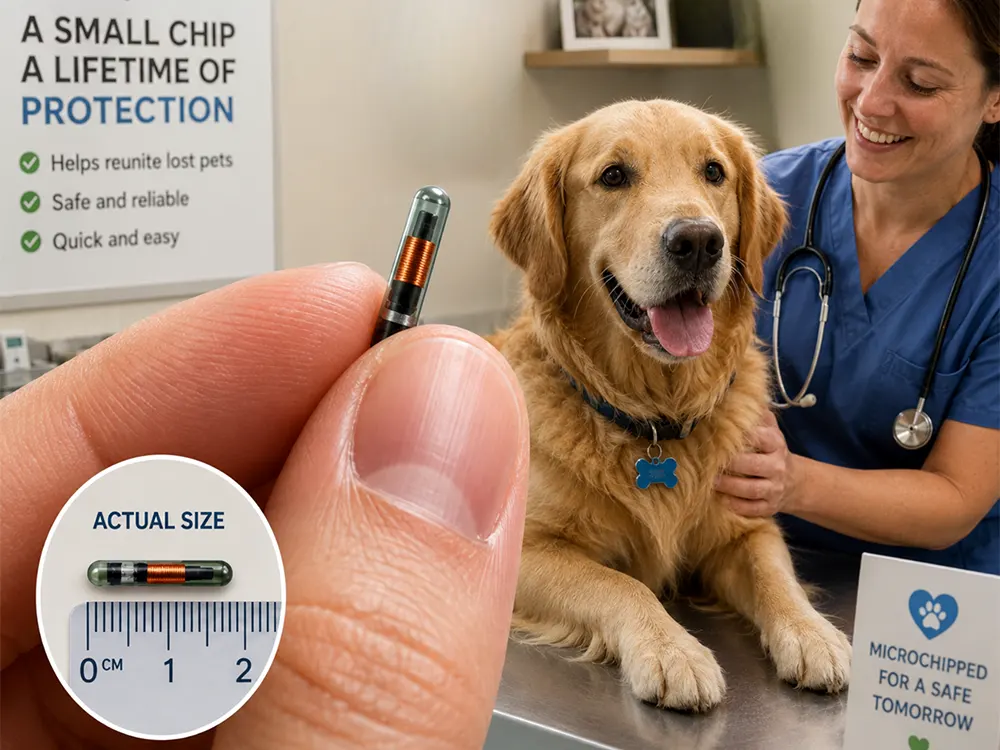
A pet microchip is a small electronic device that goes under your pet’s skin. It has a unique number that a special scanner can read.
The chip does not store your name, phone number, or address. It also cannot track where your pet is.
Instead, the microchip number links to information in a separate registry. If your pet gets lost and someone scans the chip, this number helps a vet, shelter, or rescue group find the right registry and contact you.
In this guide:
- What does a pet microchip look like?
- Does implanting a microchip hurt?
- How is a pet microchip scanned?
- What information does a microchip contain?
- Is a microchip a GPS tracker?
- What happens after a microchip is scanned?
- Implanting and registering a microchip are not the same
- Keep your contact details up to date
- How long does a microchip work?
- Should I microchip my pet?
- Check a microchip with ChipTrace
What does a pet microchip look like?
A pet microchip is a tiny capsule, usually about as big as a grain of rice.
A glass capsule seals the electronic parts and helps the chip stay safely under your pet’s skin. The chip does not have a battery and never needs charging. It only works when someone holds a scanner near it.
Does implanting a microchip hurt?
A veterinarian or another trained professional normally implants the microchip.
Getting a microchip feels a lot like getting a regular vaccination. The needle is a bit thicker, but the process only takes a few seconds. Most pets feel just a moment of discomfort.
How is a pet microchip scanned?
Pet microchips use a technology called radio-frequency identification, or RFID.
When someone moves a scanner over your pet, the scanner sends out a low-power radio signal. This wakes up the microchip for a moment, and the chip sends its ID number back to the scanner.
The number then appears on the scanner’s screen.
Here’s how it works:
- A veterinarian implants the microchip under the animal’s skin.
- A vet, shelter, or another authorised person scans the animal.
- The scanner displays the microchip number.
- The vet, shelter, finder, or lookup service searches the number to find a connected registry.
- The registry checks its records and starts the owner-contact process.
The scanner usually does not show any personal information about the owner. It only reads the number on the chip.
What information does a microchip contain?
The microchip itself only holds its unique ID number.
A microchip registry keeps the information about the pet and owner separately. Depending on the registry, this can include:
- The owner’s name
- Telephone numbers
- An email address
- A home address
- An emergency contact
- The pet’s name and description
- Details of the vet, shelter, or organisation that registered the chip
Usually, the registry limits access to this information.
Some registries may provide a contact telephone number. Others ask the finder, vet, or shelter to contact the registry first. The registry may then contact the owner directly or explain what to do next.
A public microchip search can show that a registration exists, but it does not reveal any private details about the owner. Lookup services like ChipTrace usually help find possible registries. They never store the owner’s personal information.
Is a microchip a GPS tracker?
No, a standard pet microchip cannot track your pet.
It cannot:
- Show your pet’s current location
- Follow your pet’s movements
- Connect to a mobile phone
- Send an alert when your pet leaves home
- Record where your pet has been
A microchip does not have a battery or an internet connection. Someone must hold a scanner close to your pet to read it.
GPS collars and other trackers work in a different way. They can help you find a missing pet, but they may lose power, fall off, or come off.
A microchip stays under your pet’s skin and gives permanent identification. For the best results, use more than one form of identification.
A microchip and a visible collar tag make a practical, layered system. This way, someone can identify your pet quickly if they find it, and your chances of reunion improve.
A tracker can also add another layer of protection.
What happens after a microchip is scanned?
Finding the microchip number is just the first step.
Someone must then trace the number to the registry, manufacturer, or organisation connected with it. A vet, shelter, or finder may use a national registry, an international lookup service, or a tool such as ChipTrace.
If the search finds a registration, the registry can check its records and start contacting the owner.
The exact process depends on the country and the registry. Some registries contact the owner themselves. Others give instructions to a vet, shelter, rescue organisation, or authorised official.
Even when no registration appears, the chip number can still provide useful clues. It might reveal the chip manufacturer, indicate which organisation supplied it, or suggest the country of origin.
In these cases, recovery may still be possible. The manufacturer or supplier may have additional records or may help trace the pet’s origin.
This process can increase the chance of reunion, even when no formal registration appears.
If you find yourself in this situation, read our guide: Found a Microchipped Pet? What to Do Next.
Implanting and registering a microchip are not the same
Implanting a microchip and registering a microchip are two different steps.
A pet can have a working microchip under the skin, but still have no proper database registration.
- Implantation means placing the physical microchip under the animal’s skin.
- Registration means linking the chip number to the animal and the owner’s contact details in a database.
A scanner might read the chip just fine, but if nobody registered the number, it will not lead back to the owner.
That’s why owners should always make sure the registration is complete.
Keep your contact details up to date
A microchip only works if the information linked to it is correct.
If your phone number, email, or address is out of date, it can delay getting your pet back or make it impossible for someone to contact you.
Check your microchip registry to make sure that:
- The chip has a completed registration
- Your telephone number is correct
- Your email address is current
- Your home address is up to date
- The registry lists the correct owner
You should check the registration whenever you:
- Move home
- Change your telephone number
- Change your email address
- Adopt or rehome a pet
- Move to another country
- Prepare your pet for international travel
If you are not sure which registry has your pet’s record, search the number with ChipTrace or ask your vet, shelter, or breeder.
How long does a microchip work?
A pet microchip provides long-term identification.
It does not have a replaceable battery and never needs charging. In most cases, it stays with your pet for life.
However, microchips can rarely stop working or move from their original implantation site. For this reason, ask your vet to check the chip during routine appointments. This helps make sure the chip still works and the scanner can find it easily.
Should I microchip my pet?
Yes. Microchipping greatly increases the chance that a lost or stolen pet can be identified, matched to its owner, and returned safely.
A microchip gives your pet a permanent and reliable form of identification. It helps when collars, tags, or other methods fail or go missing.
Microchipping is very safe, and side effects or complications are extremely rare. This reassures many owners before the appointment.
Collars and tags are helpful, but they can fall off or come off. A microchip stays with your pet and gives a permanent ID number.
However, microchipping does not guarantee that a lost pet will come home. Sometimes nobody scans the pet, the scanner may not detect the chip, or the registration details may be out of date.
For these reasons, keep your information current and use other forms of identification as well.
For the system to work:
- Somebody must scan the animal.
- The chip must be readable.
- The number must lead to the correct registry.
- The registry must hold accurate contact details.
- The owner must be reachable.
A microchip works best when the owner registers it properly and keeps the details up to date.
Check a microchip with ChipTrace
Have you found a pet with a microchip, or do you want to check your own pet’s chip number?
Use the chip number to search in ChipTrace or another registry lookup service. If the search finds a registry, contact the registry or follow its instructions to help reunite the pet with its owner.
You can also call your local animal shelter or veterinary clinic for further help.
If you are checking your own pet’s chip, make sure the registration details are up to date.
Type the 15-digit number into ChipTrace to search over 100 registries and lookup services.
If ChipTrace cannot find a registration, it may still give helpful information about the chip’s likely maker, country, or next contact.