
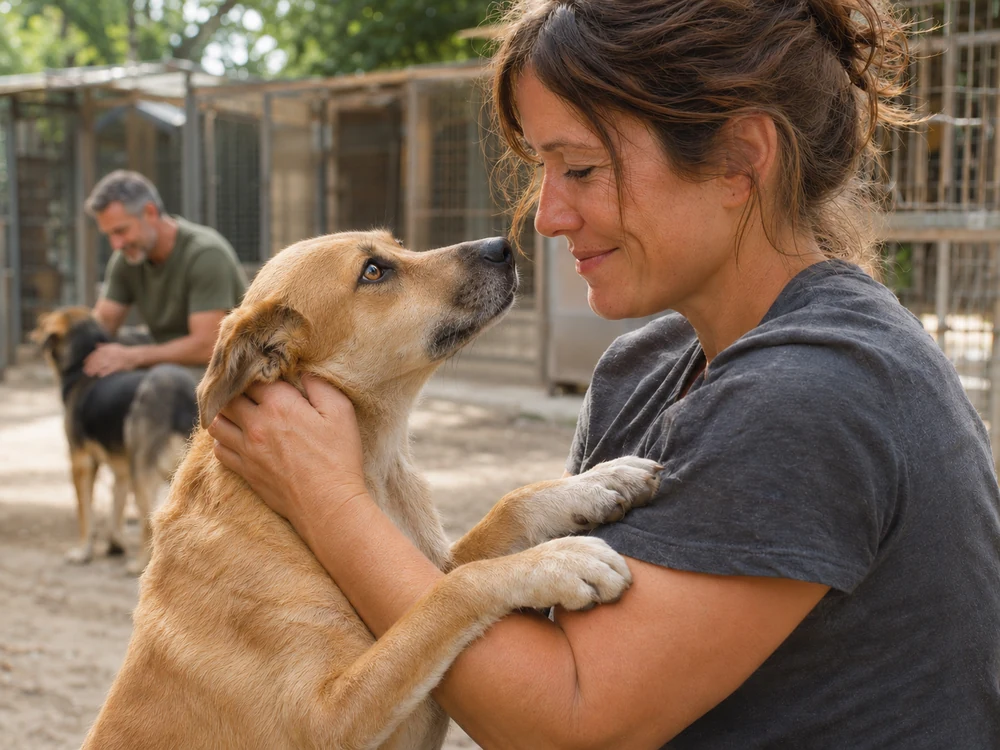
Every year, thousands of rescued dogs and cats cross international borders to find new homes. A dog or cat rescued in Romania might end up with a family in Germany. Some animals travel much further, from Asia to Europe or North America.
But which countries send the most rescue animals abroad? Where do they go, and which organisations make these journeys possible?
Let’s explore international animal rescue and what happens to a pet’s identification when it moves to another country.
In this guide
- How does international animal rescue work?
- Which countries send and receive the most rescue animals?
- Who are the major international rescue organisations?
- How are rescue animals transported abroad?
- What happens to their microchip registration?
- What should adopters check?
How does international animal rescue work?
International rescue usually involves shelters in one country working with adoption partners in another.
Some organisations arrange adoptions directly. Others work with overseas charities that find suitable families, organise transport and provide support after adoption.
For example, a Spanish shelter might care for a rescued cat until a Dutch organisation finds its new home.
In official statistics, these journeys are often called imports, exports or trade, even when charities arrange them without making a profit.
There’s also an important distinction between an animal travelling with its existing owner and one being transported for adoption. The paperwork and veterinary requirements can be quite different.
Which countries send and receive the most rescue animals?
There isn’t a complete worldwide database of international rescue adoptions. However, European movement records give us a useful picture.
According to European Commission figures for 2021, these were the main recorded routes between EU countries:
| Animal | Main countries of origin | Main destinations |
|---|---|---|
| Dogs | Romania, Spain, Hungary | Germany, Netherlands, Belgium |
| Cats | Romania, Spain | Germany, Netherlands |
These figures include different types of animal movements, not just rescues. They’re useful for identifying major routes, but aren’t a definitive ranking of rescue exports.
Romania and Spain: important rescue countries
Romania has an extensive international dog rescue network, with organisations arranging adoptions across northern and western Europe.
Spain is also a major source of international adoptions, particularly for dogs and cats travelling to Germany, the Netherlands and Belgium.
Other established rescue routes involve countries such as Greece, Bulgaria, Hungary, Cyprus and Portugal.
Germany: a major destination
Germany has one of Europe’s largest international rescue adoption sectors.
A scientific study published in 2025 describes an extensive network of animal welfare organisations bringing dogs into Germany from other EU countries, particularly Romania.
The Netherlands and Belgium also have well-established international rescue networks.
The United Kingdom receives rescue animals from abroad too, although Brexit has made the administrative requirements more complicated.
Who are the major international rescue organisations?
There are thousands of rescue organisations worldwide, ranging from small volunteer groups to large international charities.
No reliable global ranking exists for the number of animals rehomed internationally. But a few examples show just how varied these networks are.
ACE|SHIN — Spain to northern Europe
ACE|SHIN is a Spanish rescue organisation with adoption networks in Belgium and the Netherlands.
It rescues dogs and cats in southern Spain and arranges international adoptions through its volunteers and partner organisations.
The organisation reports having helped more than 36,000 animals over its history.
Galgos del Sol — rescuing Spain’s galgos and podencos
Galgos del Sol is a specialist rescue organisation based in Murcia, Spain, founded by Tina Solera.
It focuses on rescuing, rehabilitating and rehoming galgos (Spanish greyhounds) and podencos, two types of hunting dogs that frequently face abandonment and mistreatment.
The organisation operates a dedicated rescue centre and works with international adoption partners to find suitable homes for its dogs, including in Europe and North America.
Galgos del Sol is a good example of how a specialist rescue can build an international network around animals with particular needs.
Soi Dog Foundation — Thailand
Soi Dog Foundation rescues dogs and cats in Thailand and operates extensive sterilisation and veterinary programmes.
Although much of its work takes place locally, some rescued animals are adopted internationally.
Its 2024 annual report recorded 159 international adoptions.
Humane World for Animals — South Korea
Humane World for Animals, formerly Humane Society International, has organised international rescue operations involving dogs from South Korea’s dog meat industry.
Some of these animals travel to rescue partners in the United States and Canada for rehabilitation and adoption.
These organisations illustrate different approaches rather than representing a ranking of the largest international rescues.
How are rescue animals transported abroad?
Within Europe, many rescue animals travel by road in specially equipped transport vehicles.
Others travel by plane, particularly when the destination is much further away.
Before travelling, animals generally need microchip identification, appropriate vaccinations and the required veterinary documents.
International adoption transports can fall under commercial animal movement rules, even when a charity is involved and no profit is made.
For movements between EU countries, this may involve veterinary health certificates and registration in TRACES, the EU system for managing official animal health documents and cross-border movements.
A pet passport alone isn’t always sufficient.
Read the European Commission’s guidance on animal movements within the EU for the official requirements.
What about animal welfare?
International adoption can give individual animals a wonderful second chance, but it isn’t a complete solution to abandonment or overpopulation.
Sterilisation, education and improving animal welfare in the country of origin remain essential.
Unfortunately, illegal traders sometimes disguise commercial animal sales as rescue adoptions.
That’s why transparency, correct documentation and responsible transport arrangements matter.
What happens to a rescue animal’s microchip registration?
This is where things become particularly interesting for ChipTrace.
Imagine a dog originally microchipped in Romania and later adopted by a family in Germany.
The dog keeps its original microchip number, but its registration details may need to be updated or entered into a German database.
A microchip doesn’t automatically update its registration when an animal crosses a border.
The same applies to a Spanish rescue cat adopted in the Netherlands or a Thai rescue dog moving to the United States.
Sometimes the original registration remains active. Sometimes the new owner registers the animal in another country. And sometimes the registration is never properly completed.
Why can international rescue microchips be difficult to trace?
A rescued animal’s microchip may be difficult to locate because:
- Its registration remains in the original country.
- The new owner hasn’t updated the contact details.
- The microchip was implanted but never registered.
- The record is held in a database that doesn’t allow public searches.
- The chip uses an international manufacturer code rather than a country code.
A manufacturer code doesn’t necessarily make a microchip harder to trace, but it won’t immediately identify the country where the animal was chipped.
That’s why searching only the first three digits isn’t enough.
How ChipTrace can help
If you’ve found a dog or cat that may have been adopted from another country, start by searching the complete microchip number.
ChipTrace searches connected international databases and helps identify possible registration routes.
If no registration is found, it can provide manufacturer or country clues and suggest further tracing steps.
Our pet microchip country guides explain registration systems in individual countries.
For more information about microchip prefixes, see our Pet Microchip Numbers Explained guide.
What should adopters check?
Adopting an animal from another country can be a wonderful experience, but it’s worth asking a few questions before committing.
A responsible rescue organisation should be able to explain:
- The animal’s background: What is known about its history, health and behaviour?
- Veterinary preparation: Have the required vaccinations, tests and examinations been completed?
- Transport: Who is organising the journey, and how will the animal travel?
- Documentation: Will all the required identification and health certificates be provided?
- Microchip registration: Who is responsible for updating the registration in the destination country?
- Aftercare: What support is available if the animal struggles to settle in?
Don’t be afraid to ask questions. A good rescue organisation wants the adoption to succeed just as much as you do.
Every rescue journey has a story
Behind every international adoption is a network of people making it possible: shelter workers, veterinarians, transport volunteers, foster families and adopters.
International rehoming isn’t the answer to every animal welfare problem. But when it’s done responsibly, it can transform an animal’s life.
And wherever that animal’s journey takes it, its microchip should remain a reliable link to the people responsible for its care.
Because even after finding a new home, a rescued animal might one day need help finding its way back.
Search a pet microchip with ChipTrace
Useful resources
European Commission
European Commission: Movements of dogs, cats and ferrets
European Commission
European Commission: Illegal movement of pets