
Most people think of a pet’s microchip as a way to bring a lost pet back home. A vet, shelter, or rescuer scans the animal. The scanner reads the microchip number, which can then be used to find the pet’s registration and, hopefully, contact the owner.
But that small chip has other uses too. It can open a cat door, protect a pet’s food, and even help smart devices track drinking and daily habits.
What’s inside this guide
- The Naked Cat Test
- Microchip cat flaps and pet doors
- Microchip feeders
- Monitoring how much your cat drinks
- Following daily routines
- What about smart litter boxes?
- What your microchip can and cannot do
- Will every ISO microchip work with every device?
- Recognition and registration are different
- What could come next?
- One tiny chip, several jobs
First up: the Naked Cat Test
We’re following one simple rule for this article.
The product must recognise the standard ISO identification microchip already implanted in your pet.
No smart collar, Bluetooth tracker, or special RFID tag.
In other words, would the product still work if a very confused cat walked up to it with nothing but a microchip under its skin?
If the answer is yes, it passes the ChipTrace Naked Cat Test.
Most modern pet microchips use the ISO 11784/11785 system. They are passive RFID transponders with no battery. A compatible reader activates the chip when it gets close enough, and the chip responds with its unique identification number.
If you want to know more about what those numbers mean, read our guide to pet microchip numbers and manufacturer codes.
Usually, we use that number to identify a pet. But a smart device can learn it too.
The device doesn’t need your pet’s name or registration details. It simply learns that one microchip number belongs to one particular pet.
That opens up some clever possibilities.
1. A microchip can act as your cat’s house key
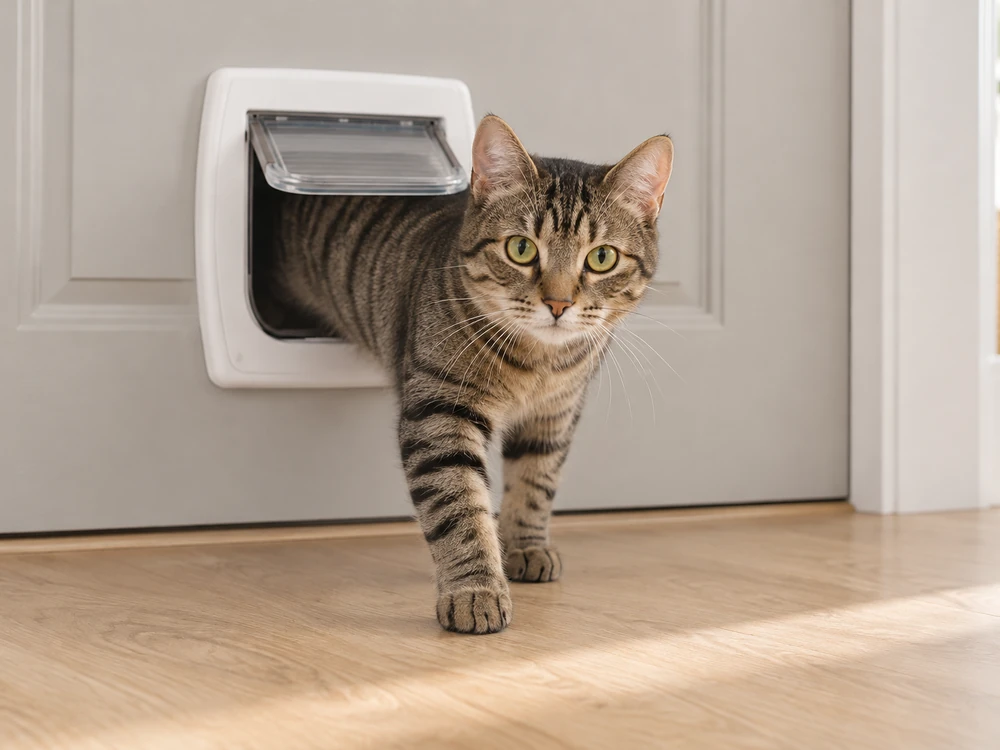
Microchip cat doors have been available for years. Products such as the SureFlap range work with the identification microchip already implanted in your cat, so there is no need for a separate collar tag.
Instead of opening for every cat in the neighbourhood, the door reads your cat’s implanted microchip. If the number is on its approved list, the flap unlocks.
If the neighbourhood food thief shows up, it stays locked.
Some models remember several pets and can give them different permissions. One cat might be allowed to come and go freely while another needs to stay indoors.
Connected versions can also record when each pet enters or leaves, tell you whether your cat is inside, and show patterns in their activity. Some let you set a curfew or change access remotely.
The microchip has effectively become a house key your cat can’t lose.
2. It can make sure the right pet gets their dinner
Microchip feeders are especially useful in homes with several pets. The SureFeed Microchip Pet Feeder, for example, works with common identification microchips already implanted in pets.
The feeder learns the microchip number of the pet allowed to use it. When that pet approaches, the food becomes available. When another pet tries, it stays closed.
This helps when one cat needs prescription food, another is on a diet, or a kitten needs different food than an adult cat.
Or maybe you just live with Luna.
Luna has finished her dinner.
Luna knows another cat hasn’t finished theirs.
Luna has plans.
A microchip feeder can’t change Luna’s personality, but it can make those plans much harder to carry out.
These feeders are also useful for cats that prefer small meals throughout the day. Their food can stay available without another pet finishing it first.
Some models can record feeding behaviour too, including how often an individual pet visits and, depending on the device, how much they eat.
3. It can help track how much your cat drinks
This is one of the less obvious uses.
Some smart water bowls, such as Felaqua Connect, can recognise individual cats using their implanted microchip. Every pet can still drink from the bowl. The microchip simply tells the device which cat is there.
This is particularly useful in a multi-cat home.
A normal smart bowl might tell you that your cats drank 600 ml of water today. Microchip recognition can tell you which cat was drinking.
So instead of:
“Someone drank.”
you get:
“Luna drank.”
Following this over time can help you spot changes in an individual cat’s normal drinking habits.
It isn’t a diagnosis, and you should always discuss unusual drinking with your vet. But knowing that one particular cat suddenly drinks much more or less can be useful information.
And Luna didn’t have to wear anything extra.
4. It can help you understand your pet’s routine
Things get even more interesting when several devices recognise the same pet.
A connected cat door can record when your cat goes outside and comes home. A feeder can recognise them at dinner, while a compatible water bowl can record their visits.
The microchip itself doesn’t record any of this. It only provides the identity. The smart device stores the information and links it to the correct pet.
The microchip holds the number.
We know it’s Luna.
Luna knows there’s food.
Everyone gets exactly the information they need.
Over time, these records can help you notice changes in normal behaviour. A cat that usually goes outside several times a day may suddenly stay indoors. Drinking or feeding habits may change.
Changes like these don’t automatically mean your pet is ill, but they’re worth noticing.
What about smart litter boxes?
Smart litter boxes can already track things such as visits, weight, and toilet habits. Some can even tell different cats apart.
So surely they can read the cat’s existing microchip too?
You’d think so.
At the time of writing, however, we couldn’t find a mainstream smart litter box that reliably identifies cats using their implanted ISO 11784/11785 microchip.
Some products use RFID but require a special collar tag. Others identify cats by weight, cameras, or other sensors.
Those systems may work perfectly well, but they fail our Naked Cat Test.
A future litter box that reads an implanted microchip at the entrance could be especially useful in a multi-cat home. It could connect visits and other information to the right cat without requiring a collar or tag.
We’ll be watching this one.
What your pet’s microchip can and cannot do
All this technology can make a standard pet microchip sound much more powerful than it really is.
It isn’t GPS. It doesn’t know where your pet is, connect to the internet, or constantly transmit a location.
It also doesn’t store your name, phone number, feeding habits, or medical history.
Its main job is much simpler: provide a unique identification number when a compatible reader scans it.
Different systems can then use that number in different ways.
A registration database can connect it to an owner. A feeder can use it to decide who gets access to food. A cat door can use it to decide who gets inside.
The number is the key.
Will every ISO microchip work with every device?
Not always.
ISO 11784/11785 microchips are widely used worldwide, especially the 134.2 kHz FDX-B type. But you should still check compatibility before buying a smart pet product.
Reading distance matters too.
A vet can move a handheld scanner around until it finds the chip. A feeder or cat door can’t. Your pet has to bring the implanted chip close enough to the reader.
The chip’s position and the device’s design can therefore affect how well it works.
Always check the manufacturer’s compatibility information before buying.
Recognition and registration are different
A microchip feeder doesn’t check a pet registration database before opening.
It reads the number directly from the implanted chip and compares it with the numbers stored in the device.
This means a feeder could recognise Luna perfectly even if her registration details were completely out of date.
But registration still matters.
If Luna disappears and turns up at a vet 20 kilometres away, the vet needs her microchip registration to lead to your current contact details.
If you’re not sure where a pet’s microchip is registered, you can use the free ChipTrace microchip lookup to search for it.
The cat flap may know exactly who Luna is.
The vet still needs to find you.
What could come next?
Millions of pets already carry a permanent, machine-readable identity.
They can’t forget it, leave it on the sofa, or run down its battery.
That makes the standard pet microchip an interesting identity key for future technology.
Smart litter boxes could recognise individual cats. Home systems could potentially combine information from feeding, drinking, doors, and other devices.
The microchip itself doesn’t need to become a tiny computer.
Sometimes a smart system only needs the answer to one simple question:
Which animal is this?
One tiny chip, several jobs
Helping a lost animal get home is still a pet microchip’s most important job.
But it doesn’t have to be the only one.
The same ISO microchip can already open a pet door, protect a food bowl, identify a cat at a smart water station, and help connected devices build activity records for individual pets.
No extra collar. No special tag. Nothing extra for your pet to lose.
Unless you’re Luna.
In that case, unfortunately, the microchip feeder now knows about the third breakfast.